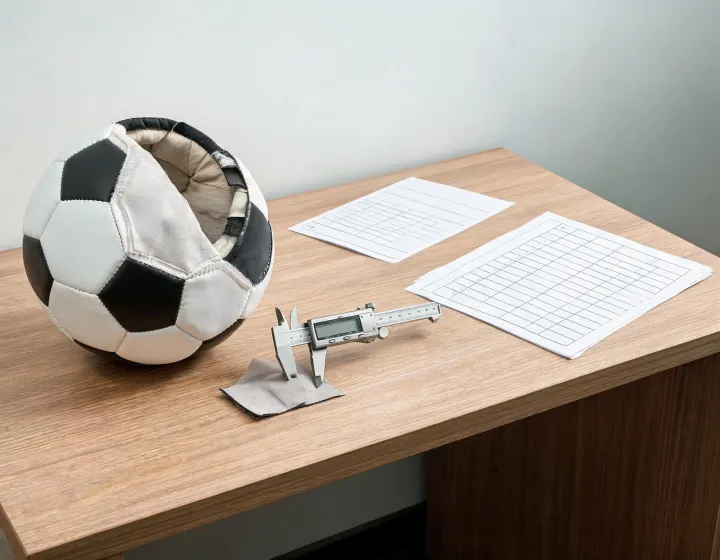
Put the joining method in the sample brief and make the supplier prove it on the lot the sample came from. The word bonded on a quote proves nothing by itself: not which technique, not which inspection record, not what your order actually carries. That is my call, and it holds until the project stops needing what bonding buys.
The case that flips it comes later in the piece: if your own use test on a hand-sewn sample already clears the bar and nobody in your program pays for a smoother surface, the bonded line is over-spec. One reference holds up everything below — the 2021 Molten dealer catalog, soccer pages 33 to 36 — one brand's own models in one version of one document. Nothing in it describes your factory's ball.
Your brief should name the construction, not trust the label
The line I use asks four things in writing: which technique joins the panels, which panels it joins, the inspection record for the sampled lot, and whether any stage is subcontracted. A supplier who can answer all four controls its line. One who cannot is quoting you a word.
Keep the sentence blunt and short enough to survive translation, a change of sales contact, and the second sample. Blunt questions also close the usual dodge, which is answering with the word bonded again.
Expect at least one reply that names a technique you cannot check, such as a trade name the factory will not define. Ask what that name means in their process and who signs the inspection record; a trade name without a definable process is the same as no answer.
Ask one more question while the brief is open: where the junction falls relative to your artwork. A custom print may cross a panel, and the answer tells you whether the design sits on a flat band or runs over a join. That is a layout decision you can only make before the sample is built, not after.
Watch the wording when you borrow process language. The technique named in the Molten pages belongs to that brand's own soccer models and that version of the document. Lifting it into your brief as the generic name of bonded construction invites a factory to agree to a word it does not use, and you will have specified nothing.
What the 2021 Molten catalog does and doesn't prove
Cross-fusion bonding replaced traditional hand-sewing there, for a smooth, seamless surface and a quicker, more responsive ball. A multi-layer architecture is described as sharply improving roundness, shape retention and durability. Quality control runs at each manufacturing stage, with every ball passing all of those inspections before the logo goes on.
I opened the archived 2021 PDF and read soccer pages 33 through 36 myself. I noticed those statements sit in model-specific bullets written about the brand's own balls, and I found no line on those pages that extends them to a custom order, an OEM run or another factory's output. I also checked whether the document says anything about current customization eligibility, artwork dimensions, minimum quantities or pricing. It does not.
Treat those pages as a worked example of what a process-led description sounds like, and as evidence that a brand can only make the claim because it controls the stages behind it. When production moves to another plant, the claim stays in the catalog. No custom ball order inherits an approval, a certification or an inspection regime from a dealer PDF; those belong to specific models and to the people who tested them.
Check the seam yourself before you approve
Suppose a sample is on your desk and the paperwork says bonded. Here is the check I would run, as a plan rather than a result from your ball. Hold the junction at raking light: evenly spaced needle holes or exposed thread ends at the join tell you the panel was stitched, however clean the finish looks.
Run a thumbnail along the junction. A raised step or a perforated channel feels different from a continuous, flat band, and your thumb catches what your eye forgives at arm's length. Suppose you compare junction width across several panels: a bonded band tends to read more consistent, while hand work tends to drift with the operator.
Photograph the junction close up and file it against the sample ID. If the photo shows regular perforations plus thread, the ball is stitched and the construction line in your brief has not been met, whatever the quote calls it.
What I would measure for roundness and shape
Suppose you want your own check on roundness: tape the circumference on several axes at the inflation pressure the supplier states for that ball, write every reading down and keep them together rather than averaging them into one comfortable number.
Repeat the same measurements after the use period you have agreed with the supplier. The reading that matters is the spread between axes and how it moves. A spread that grows, or visible panel distortion at the same pressure, is the signal to hold the lot and ask what changed. When the reading holds steady across the use period, the claim survives for that sample and nothing more.
Write the pressure figure and the date on the sheet. Without both, the readings describe a ball on an unknown day and cannot be compared with the next sample.
What you have after measuring is your own record on your own sample, which is the only thing that belongs in a review of your supplier.
Notes I would put on the sample approval sheet
Approval is where a sampled process either carries into bulk or dies. The sheet should carry the named joining process, the technique the supplier says it uses for that lot, the lot inspection record, and the junction photograph taken during the check. Appearance-only sign-off cannot separate a bonded panel from a well-finished stitched one.
I would not sign a sample where the process line is blank and only the look was reviewed. I would also write a retest trigger into the sheet: a change of production line, a move to another plant or a subcontracted stage brings the sample back to the table, because those are the moments when the process changes quietly while the part number does not.
If the record never arrives, treat that as an answer rather than a delay. You are then buying appearance and a price, so inspect incoming lots yourself and write down what you see; a supplier who cannot document the process can still ship a ball you accept, but only if you carry the checking.
When bonded construction is the wrong call
Here is where I take a side. On a low-cost training ball program, with a hand-sewn sample that already passed the test your own players or buyers put it through, and nobody paying for a smoother panel, insist on hand-sewn and spend the effort on inspection records instead. Specifying bonding there buys a process difference your customer will never feel, and it can cost you the supplier that would have been dependable on what you actually need.
The conditions that move me back: you need the seamless surface for touch or for print quality across the panel, your supplier can show a bonded lot record you can verify against the sample, or your field data shows stitched junctions failing the way you use the ball. Keep the rule on one line for the team: a stitched ball with records beats a bonded ball with none.
Open the brief you are about to send and add one line: state the panel-joining process for this lot, name the technique, and attach the inspection record for the sampled balls. Send it back before any sample is quoted, and you will learn quickly which factories can answer and which ones only repeat the label.

Leave a procurement question