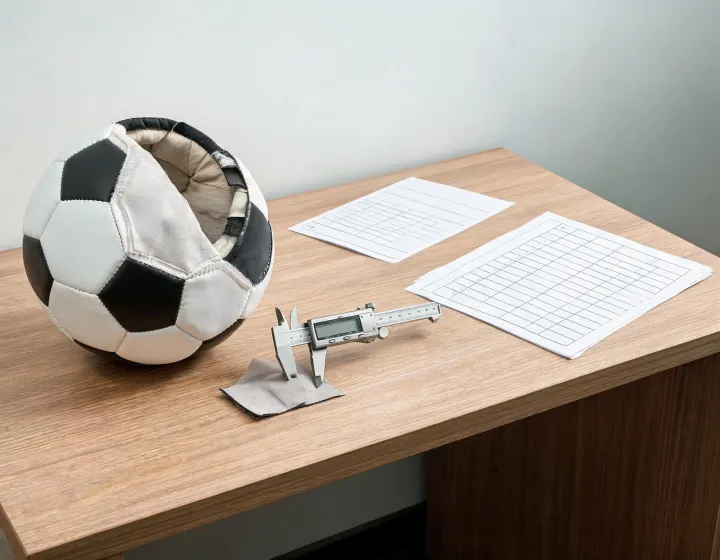
A QC lead stands at a receiving bench with three things in front of her: a deflated custom soccer ball, a pressure gauge, and a printed page from the 2021 Molten dealer catalog with the latex-bladder note circled. She has to decide this week what goes into the QC brief for the ball she is about to buy in volume. The scope matters. Those catalog pages cover Molten soccer customization examples from that 2021 edition, not a live specification for whatever factory she is talking to.
Her question is narrower than it looks. Which pressure-retention criteria belong in the brief before a sample gets approved, and which are still open questions to put to the supplier in writing? The order is not negotiable: bladder material and the current standard version come before any number.
Start With Bladder Material, Not a Pressure Number
The mistake is writing a pressure-retention limit before naming the bladder. It happens constantly, because a number feels like progress. A buyer copies a figure from somewhere, drops it into the brief, and the brief now assumes a construction nobody confirmed — usually latex, because that is the construction the published example describes. If the ball turns out to use a different bladder construction, the brief has been measuring the wrong thing since page one.
Latex bladders lose air pressure over time because they are made of natural materials. That is a material-specific premise, and it explains why a loss figure gets attached to latex in the first place: natural rubber walls let air migrate through them, so a latex ball sitting in a bag for a week reads lower than it did the day it was boxed. None of that transfers to a bladder the buyer has not identified.
So the first line in the brief is not a limit. It is a record: bladder material, model code, and the standard version the buyer intends to cite. Only after those three are written down does a pass or fail number become answerable.
A 2021 Catalog Is Not a Current Standard
Buyers get into trouble here. The catalog says, in plain text, that per FIFA standards the allowable loss of air after three days is 20%. That sounds tidy. It isn't.
Three documents are in play and they are not interchangeable. The first is the 2021 catalog statement itself, attached to that edition's latex-bladder soccer pages. The second is the current standard text the buyer can actually cite, in whatever version is in force at the time of the order. The third is the supplier's lot-level pressure report for the specific ball being made. A brief that collapses all three into one line is quoting a 2021 manufacturer page as if it were an acceptance criterion.
The obvious objection is that the catalog itself says FIFA standards, so why not just use the figure? Because a label on a 2021 dealer page is not the standard. Standards get revised, and the number, the test method, the conditioning period, and the inflation pressure at the start of a test can all differ between versions. A page printed for dealers does not carry that detail. The buyer needs the version and the bladder construction, not the label alone.
Write the 20% after-three-days line into the brief as a historical reference with its year attached, then add two open requests: the current standard version, and the lot pressure report.
Bonded Seams Say Nothing About Bladder Leak Rate
The mistake here is reading the catalog's cross-fusion bonding line as proof the ball holds pressure better. Bonded sounds more advanced than stitched, so the mind fills in tighter. Drop that into a brief and bladder-specific checks disappear, replaced by a surface claim.
Cross-fusion bonding does what the catalog says. Molten replaced traditional hand-sewing with the technique for a smooth, seamless surface and a quicker, more responsive ball. Note what is not in that sentence: no pressure-retention value, no leak rate, no test condition. The claim is about surface and response, and it should stay in a surface column.
Keep two columns. One holds surface construction — bonded versus hand-sewn, seam uniformity, panel alignment. The other holds bladder material and pressure retention, with the standard version and test method named. They answer different failures. A bonded ball with a leaking valve still loses air; a hand-sewn ball with a sound latex bladder holds it. Conflating the two lets a supplier answer a pressure question with a construction brochure.
Pad Printing Limits Belong in the Same Brief
Approving artwork first and asking about print restrictions later is a common sequence, and it costs a second approval cycle at the worst moment — usually after the design has been shown to a team or a distributor and declared locked.
The 2021 Molten catalog is explicit that pad printing carries conditions: minimum purchase quantities may apply, and there may be restrictions on logo placement and color. Those are the things that turn a design into a reprint. A logo that has to sit lower than the artwork specifies, or a color that will not hold on a textured panel, is a schedule problem rather than a quality problem, and schedule problems are cheap at artwork stage and expensive in production.
Before sign-off, put three questions in writing: whether a minimum quantity applies at the size the buyer actually wants, which placements the printer will not accept, and which colors are out of range on the chosen panel. The catalog establishes that the conditions exist; it gives no current values or approval rules, so the answers have to come from the supplier, dated and attached to the brief.
Do Not Let a Pretty Sample Approve Itself
Signing the approval on look, feel, and print quality alone leaves no pressure basis at all. The ball arrives, it is round, the panels line up, the logo is sharp, someone signs. Then a batch comes in soft after a week in a warehouse and there is no fixed reference to argue from — only a memory of how the sample felt in a room.
The approval record should state four things: the standard version being cited, the bladder material, the test method and conditioning period, and whether the catalog's loss figure is being used only as a historical reference. Those four lines convert a felt judgment into a citable basis.
A skeptic would say a sample is just a sample, so why burden the approval with paperwork? Because the approval is not a verdict on one ball. It is the moment the buyer chooses an acceptance basis for every ball that follows, and a written basis is the only thing that keeps a later batch dispute from becoming a contest of recollection. No independent test has been run here, and the brief should not imply one; it requests data rather than claiming a pass.
Hold Approval When the Pressure Basis Is Missing
The failure at the end is filling silence with assumptions. A supplier does not answer the standard-version question, so the buyer treats the 2021 figure as a current tolerance. Or MOQ, lead time, capacity, and customization authority get estimated from a reference brand's catalog instead of from the factory's own quote. The brief then contains promises nobody made.
Set the cut-off now. A candidate that will not provide the current standard version, the bladder material, written customization restrictions, and sample or lot pressure data does not get a signature. The item stays on hold and the gap stays visible in the brief instead of being papered over with a number.
One more split worth enforcing: soccer and volleyball production-code rules stay apart. Ball families carry different codes, sizes, and construction conventions, and a rule lifted from one line and applied to the other is not a small error. It is a specification written for the wrong product.
The tradeoff is speed. One catalog number looks like a universal pass or fail line, and giving it up means the approval waits while documents come back. What the buyer gains is a brief where every line can be traced to a dated source or marked as still open, and that is what makes a hold defensible when a later shipment disappoints.

Leave a procurement question